We asked for creative and critical work that responds to the future in any form. Lost futures. Dead utopias. Digital futures. Modernism and Futurism from a 21st-century viewpoint. Eco futures. Climate dread. Hope. Personal futures. Political futures. Prophecy. Apocalypse. Stagnation. Acceleration. Self-actualisation.
What future were you promised? What do you no longer believe in? What does hope look like now? What art, music, fashion, or writing will be influential over the next ten, hundred, or thousand years? What mark will this generation leave? Do you see a future at all?
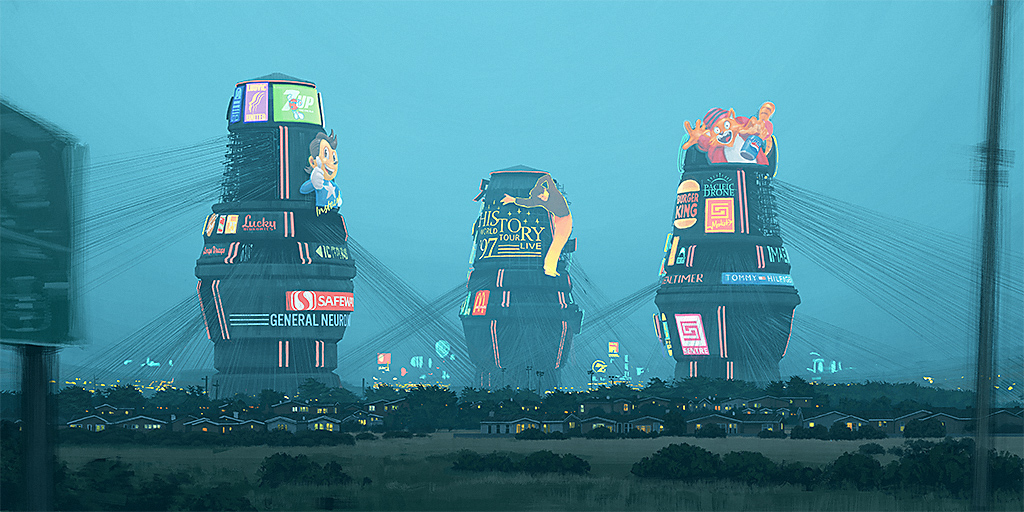
Simon Stålenhag, The Electric State (2017)
A New Humoral Composition, Heavy Digestations
“As we continue to spend more time in our cyber rather than our physical space, I speculate on the future of human behaviour regulation. Technologies that are described as black boxes, transcending human understanding, and developing with our participation may plunge us back into the dark ages, their unknowability leading towards regression. For the possibility of this future, I have revised the four humours and their qualities, as demonstrated in the diagrammatic poem, ‘New Humoral Composition,’ assigning modern vices as secretions of deficiency, separation, and excess. NHC is written into existence using the web development languages, HTML and CSS and combines diagrams, code, alchemical symbols, and words, using format to produce deeper meaning.”
What’s On? , George Guest
What then? The place will sit empty a bit, the appliances alive and alone in vacancy. A full fridge and a bosch branded oven with no one to fill. I’ll tear out of The Day it Rained For Ever — that copy that sat in the west facing window and had its crown browned manilla by mornings — and leave behind that first, or third, that early story: where the automated home loses its friends but never its motor, its energies never expended in overflowing their glass of orange juice, with scoring browner, blacker furrows on the same stale toast.
The fridge will hum, in which there could never be dips enough to slick, like blessed water to the wafer, all I’ve to choke down. I’ll lose and regain my motor, my energies. Winter coming on, the fruits in the fridge will be ridden by a closet of fine silver furs. An old lady smell of veg and death, cruciferous. At intervals of old thirsts and scrubbing, the taps will still make a sound of a just-cracked toniccan. The clockwork mouse’ll take steadily, mourselled its cheese.
Like a previous person’s bank statement, or mail order magazine, award or old acquaintance, my alarm clock will still ring at this address. Its reverberations in the sheetcreases and heaped duvet will freeze in the simple manshapes of instructions for the semaphore of my waking. I’ll have gotten out of bed by then. I’ll have maybe switched off the tele, or left a fizzy gabardine going over its screen. Finally take out the bicycle doubled up in the hallway like a cod cuddling in a pot. And the bins – urinous and big.
The signal-gauzed, signal-grey ear of the tele dish will keep communing with near space. It suggests of the heavens, in their hectic grammars of hissing, some entertainment for me; something surely is topical and chatty in late-night starlight amongst the foxed reruns of creations’ afterglow. Though there are now more stations to play than dots in the scattergraph of satellites and signalhunks, lugged and husky, twinkling errant and misplaced through space, by which to indicate their clef and measure.
All the talk I had will make it out through the pores of the place, with an unhappy gastric clank in the gaspipes. Its happening there will be looked on as strange, like lyrics written in english by singers of another language. So then: there will then be a lot of silence. It was put there by all the bad jokes that I made, and its titter sounds like spent change jingling. The air has thin skin, if someone slaps or embarrasses it, they can see its bruise and blushing.
Needing more urgent treatment, the patch on the ceiling will worsen with water. It will grow from something found under a fingernail to a black tantrum at the rafters. Then, it’ll release itself, its rain, and my clay, nude, bathing neighbours into the sink and the teacups I failed to clean. Stains. Great innovations in modern painting will have to be made over blu-tac marks, leaving a coat of sampler the colour of a shirt collar in the dead of summer. And several seasons are to be banked up by the door before then; warming pavement grains, star anise leaves, sweat and once was snow staining the wood.
I’ll have left on the high standing lamps that cast a shadow through the closed curtain rungs of two hands meeting at the fingertips. And the one of those mitts will deal shade to the neighbours pruning and barbecues and t-shirts crucified and drying on the line. The other, which roof slates would be desirable for bathing birds if there were any; the little clockwork mouse will perhaps coddle the clockwork of his mousesoul, and slow, and then perhaps stop, under them, big and greenly heaving with my cheese. Or I’ll leave them off, and let ginger hands of sun instead hold the couch and hold the tongues still of talk.
A really great rain, the kind I’d like to have sat inside it for, will come one day in big, gusted antlers, and stay as threaded fat down the windowpanes with no one washing them. The bowed head of the shower will seem as if so from cowardice. If I leave the windows open it’ll bloat the letters of that Bradbury story lying, leisured, by — I’ve decided — the former fruit bowl; the gravestones and lampposts of its ps and bs will lift or lower themselves to each other. It’ll take the aerial with it, so that there might not be a quiz show away at the back of all meals taken alone, and that all war and broadcast might cease, all screensavers be returned over to nature. No one can really move in and nothing really will be on.
slurping the milk, tilly foulkes
if we are to sit in black rubble hell counting our seconds we must do it in pretty milkmaid dresses tits out white teeth butter churning with eyeless children chained to smog hands in the air canoodling along my boyfriend the computer with no face spits in my mouth if i eat anything but seeds five trillion people dont smile but look at me deface myself over and over and over again he uses his big thick hard gigabytes to track when my breasts are most tender when my pussy is most fertile when it’s best for my decisions to be made by data analysis because im prone to lutealphase hormonal brainfog and theres nolight behind my pretty eyes behind my Super Soft BabyFace Eyelashes Extended By The LASHBLASTER 50000: what every girl needs! for £19.99 a month have the natural eyelashes of a twelve year old girl unwhored by growing up whore chained pump sticky white substance into eyeballs until delicate secretion now i see beauty everywhere i go i slurp my own breastmilk because its natural its natural my biceps are huge from all this butter churning i nibble on the muscle i am starving to death
Flowers From My Mind (oil pastel and acrylic), Wobble Studio (Chelsea Humado)
“This explores a surrealist future of florals, seeing these natural forms warp and twist into bizarre shapes. The flowers walk along the fringe of real existing species but appear like new mutations, with the oil pastels giving an extra hazy and weird texture on the canvas.”
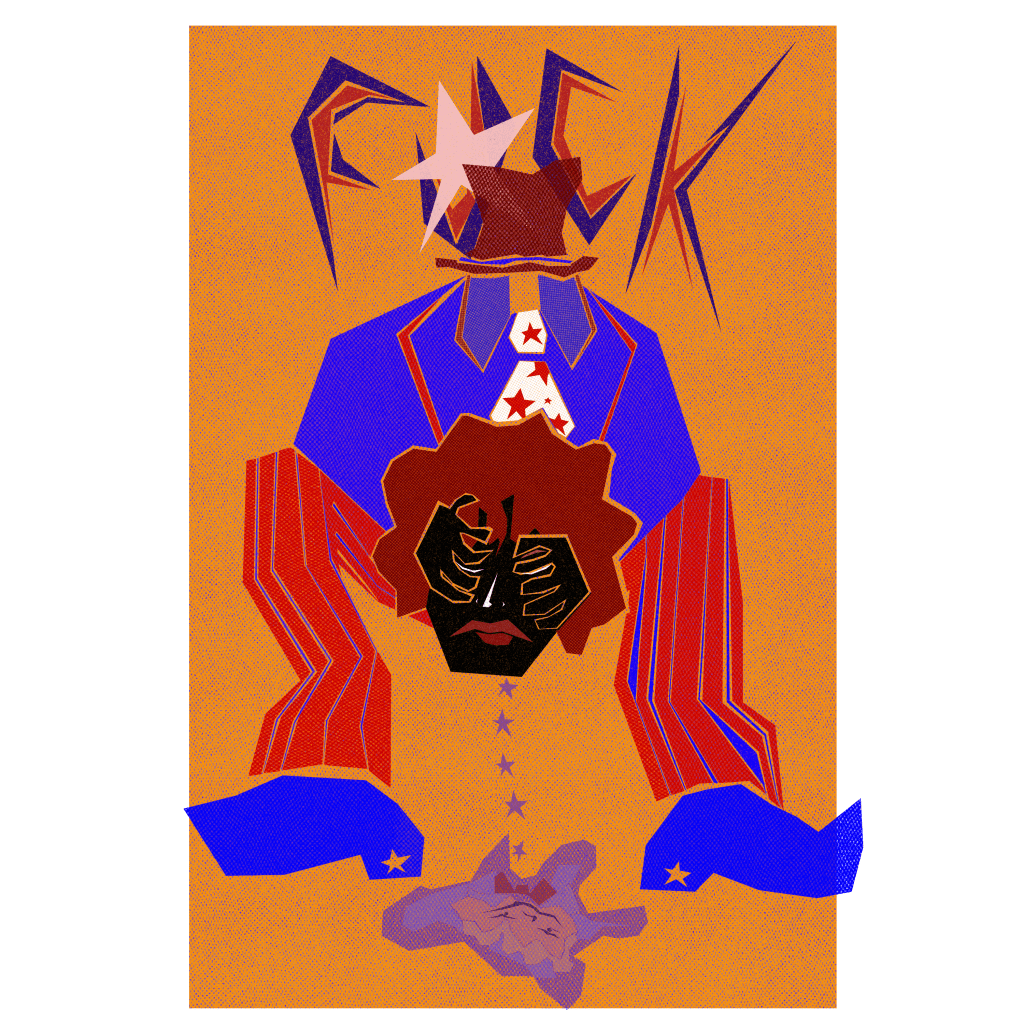
America Has a Problem (digital illustration), Wobble Studio (Chelsea Humado)
“This depicts Uncle Sam in deep regret, aware of his failures and the changing times. He cries a pool of star-studded tears into a pool reflecting Donald Trump, who looks back with his villainous grin. The word Fuck is starred out too, commenting on censorship even at a low point, and the font (my own font!) is inspired by 50s comic strips and the sort of onomatopoeia used by artists like Roy Lichtenstein, another icon of “golden” Americana.”
Call Me Whatever (digital illustration), Wobble Studio (Chelsea Humado)
“Call Me Whatever has a similar nature of frustration over the political climate in the UK. With a fragmented recreation of the Union Jack splashing in a colonial yellow into the sacred colour way, the protagonist covers their ears as a rejection of the verbal abuse thrown around every day in an ever-growing, oppressive environment. There’s a cynical exhaustion behind the piece with the words floating around directly targeting this disappointment, “you can call me whatever you want, the English language means nothing to me now.”
The Window Frame, Amélie A D Watson
The window frame chips and tarnishes
time-worn metallic flakes that
change the symmetry of the choking world
before me.
I feel it more when it is sealed
air-tight and I am
drenched in the cold sterility
puffed out of the slits in the wall
as it dries out the skin on my lips
and cuts deep the lines of my
face that curve down –
always down these days
I loved it when I was a child;
lineless and still sweating,
watching the sun make its descent
journeying through the swollen landscape;
hazy and floating
drowning sluggish in the dense
air grasping the clouds and
wearing them like a halo,
glowing red with the
vibrance of something that knows
it will soon fall away.
The dark sky shines by
the lights that it covets and
hordes from the streets below,
shining with fluorescence
that mocks the stars
we no longer see,
I feel it more here, suffocated
by the scars of my species
ancient and braided into the
makeup of what is tangible around me
as if the earth could not exist
without it
the way that a body
may feel hollow when once rid
of the parasite within.
Intelligence, Anna King
Snail tracks were on the carpet yesterday,
I found them in the morning, liquid silver
felt my stomach fall to grey, phoned my mother
wiped them viciously away.
The pantomime was up some hours before
your key snicked in deliciously –
a warm note of your coming, once I
had purged all badness from the floor.
This morning there are white wolves in the air
planes inch like millipedes across the sky
the rug is clean; my heart is empty;
bold things lurk out there.
I will concede I miss the rain – the rain
that ushered in the snails, no less,
and softened all the dizzy space
below, the sea of stone
which flattens by the day, a restless
unbecoming, and the seaweed skies
make beds for hatching ecstasies
of generated numbness.
I’ve lost the shimmering boundaries
of a coast, eat in the metalwork
of stark outlines; storms of too-dark
certainty; love that only marries.
I’m frightened by the spider sacs
glowing in the leering ether
dashing weather – but I want the cure
for morning snail tracks.
I Keep Waking, Anna King
I keep waking
with this hurt in my arms
with this ache, stretching
from shoulder to elbow
a lean fire built in my back.
I have been wrestling
again, yanking too hard
on my dreams, goring
the night with my head,
jutting and birthing
a wide red stream
glittering in the woolly
darkness.
I’ve been holding
the soft pieces
too tight; in the morning
my fingers take time to
uncurl. It’s like when I was
young, and made deals with
God – if the answer is yes,
I will still be holding this
rosary when Iwake ––
and every morning it had
slipped down from
my hands, and fallen by
my feet.
Extracts from Silences Still To Be Heard, David Ward
There were clouds in the sky,
but the rain did not fall.
The leaf heard a sigh
but it wasn’t the wind.
Dust touched the petals
as they hung frail and dry.
The stone slept on
in the heat of the sun.
*
The ice shivered.
She had never thawed,
but when she melted a new rain came.
The new rain brought a season
that the birds had never seen.
The dust was slaked.
The rivers spilled.
This was a season of changing light,
of burning moons, of sleepless dreams.
In the ditch, a lizard woke
and crawled towards the rain.
*
The sparrow woke.
She knew that she was hungry
and filled her belly with berries,
but the berries tasted bitter.
She drank water from a puddle,
but the puddle was sick with smoke.
She flapped her wings then
to perch in the branches of a tree
and the tree rocked her gently
while the spiders spun their threads
till she was wrapped in a web
safe from the silence and the rain.
*
They found a skull by the dry river bed.
Its eyes stared empty.
As they sniffed the air for the searing wind,
they could not tell what creature it had been
or what it had dreamed.
They could not tell how long it had lain in the sun.
Even its bones had gone.
21/05, Rose Westrip
I feel like a toddler learning to walk and how to do her laundry and how to grow teeth, the swelling from my wisdom tooth down, but not enough for me to forget that I am teething. I play with the ulcer on the end of my tongue. I play with my best and worst fantasies like a toddler plays with alphabet blocks, but the kind of toddler that beats themselves up when they put them in the wrong order or loses one behind the sofa. I have my eyes closed and my hands out and I am wading through the dark.
Light and Shade, Rose Westrip
Somewhere, there is a house,
with tiles in the kitchen
white squares with navy diamonds in between.
A wooden island floats,
with a lamp sitting on it
concertina shade.
It is cut up by a streak of light from a window.
Green shutters open to reveal chipped paint on the frame
there are oranges on the side
and there is parsley in the fridge.
There are little silver metal bowls to put olives in
and bookshelves in the living room across the hall.
It’s the good kind of quiet
and the good kind of warm,
my head is as empty as an olive,
heart as full as an orange
and I stand barefoot
painted toes
elbows on the island
eyes closed,
facing the light
Swans, J Mitchinson
2024
Two familiar swans had six signets; there have always been swans on the lake at Princes park but never more than one couple with signets which I find a bit odd.
In the park last summer I was told one signet had been killed and that the other five had been taken to a reserve because of that and what I saw in the park were two grieving adult swans who did not seem to know what to do.
Some time passed, however I noted Spring 2025 there were no swans or signets and I felt sad.
Then today having heard a myth put to music by a certain composer (very Famous), played on Radio 3 about a lover who shot by bow his lover who then turned into a swan; a small cry away from the enchanted princess and prince both turned into swans in Swan Lake.
I sure hope more swans turn up and perhaps a return of signets in 2026 when we will celebrate Judy the donkey’s centenary. Plans are underway, Liverpool arts lab.
Had a lovely day most beautiful really, playing flute to any ears in the sunlight, the storm’s wind though still removing and editing my notes calming to the still outside now.
2026
There are no larks in Lark Lane,
Nor otters in Otterspool.
Now there are no swans in Princes park
Will soon there be no rock doves, nor wood pigeons,
Nor ducks at that?
Will bees be buzzing in 2033
And just how big will the park’s Redwoods be?
Thank you spiral tree, thank you oak, thank you willow, and birds and FOPP.
would forward be future?, Emily Turnbull.
Forward as future. To be sure not sure sure not sure or maybe the whole time its all been facing the wrong way, (if IN FACT there is a RIGHT WAY to face).
The old future in a straight line ABCDE, you know. Straight line like forwards bright and blistering laser into toxic utopia. Poison great mind illness ready for a hunt to solve it all. Burning in gas: futurism. Manifesto to chrome tower rocket decay and born again and again. Wasteland recycled.
One Name, An Idea Of Progression. Falsenesslessness, in uncanny postured god-mask, post-scalping, with flesh and blood and bones to prop it all up. Horizontal.
The stiff posture, upright spine unbending with pinprick eyes staring into horizon sun. blinding. Mirages of another and another and another horizon. Endless horizon. Archived Horizon.
BLUESCREEN EDEN
Kiss my tired eyes installed to next century; over the bruise.
2000.
Sci-fi stole my jeans again. I’ve been wearing them since 1965. Interdimensional impossibilities realised. I say thank you to my phone. Thank you, phone, thanks.
Mum says it to the box that sits on top the broken tumble dryer. Hahahaha. “What is the weather like today? Can I hang my washing?”
The face unlocks the door.
Then its all: Drones over hot grass, quick miraculous disappointment. Accelerating to never arrive. To rinse and dry out and rinse in its own dirty water, stewing forever.
Is this forwards?
I miss 1967. (Tell me about the future, twiggy).
Or then to Knebworth, 1996 on new released documentary, living forever (horizontal).
Please, record skips unreleased future and then finding its entire discography on a small screen, while remaining unmoved and HORIZONTAL, fumbling around on the bed. Can someone call it for me?
Tomorrow in an old suit, same bones, teeth worn down to molecular dots, impotent. Shrinking further against wheezing laugh. Smirking endless victory, withering.
Silver thumb Over Glass Call Dad See Face I Love You.
Spitting out childhood putty. I Could Always Forgive You. That is Beyondness.
I don’t want to drag this historical body by the neck and hair into another veil-perfect mechanism revelations containing maggots and bin juice.
So, arranging perception. Future arriving before boardroom preplanning. Blooming in reversal tapes and looped round back again, looping there to unlock <NEW TIME>. Waiting, resting, patient, in sealed nerve endings present before any dawn.
Cutting the clock, sliced, flayed.
open
no hands. moths. tiny weather.
Defending. New Time. As.
Newness strange and unforced
Subtle illuminations sitting unnoticed in dark corners, collecting, scattered, everywhere. All the dripping sprayed up the walls, invisible ink for blacklight future. In alleyway charm and portable charger, solar happiness. Hatched, nurtured in unrepetitive collective cycle like wind. Floating every which way to return up towards the sky again. Tomorrow is blooming (in reverse).
Texting how are you?
All Expressed In Analogy. Everybody say: thank you, aliens.
when forwards was future, Emily Turnbull.
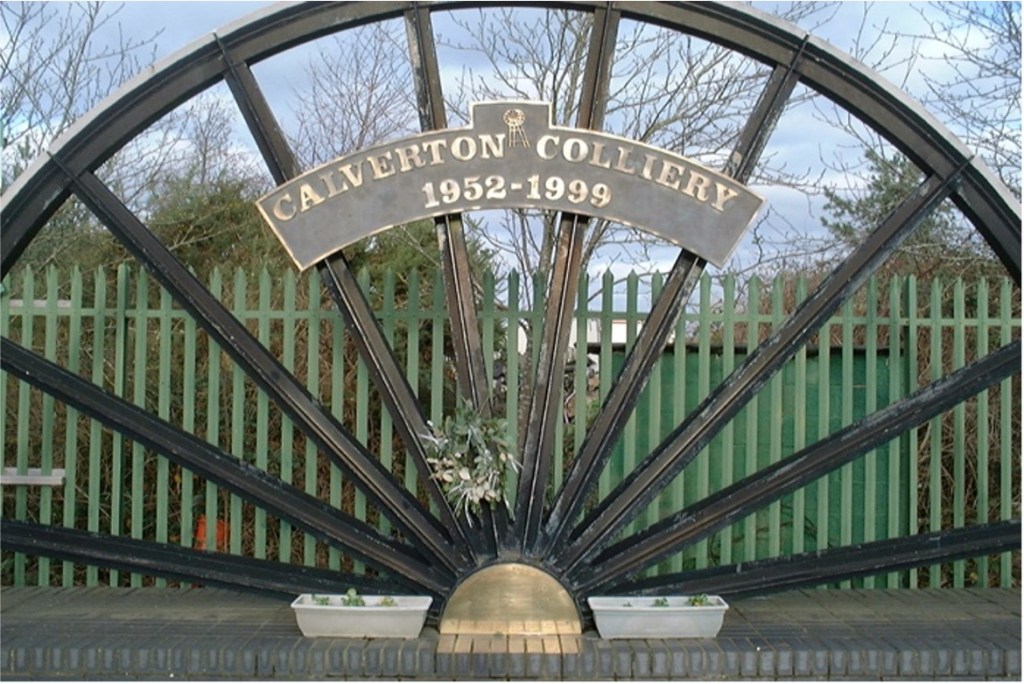
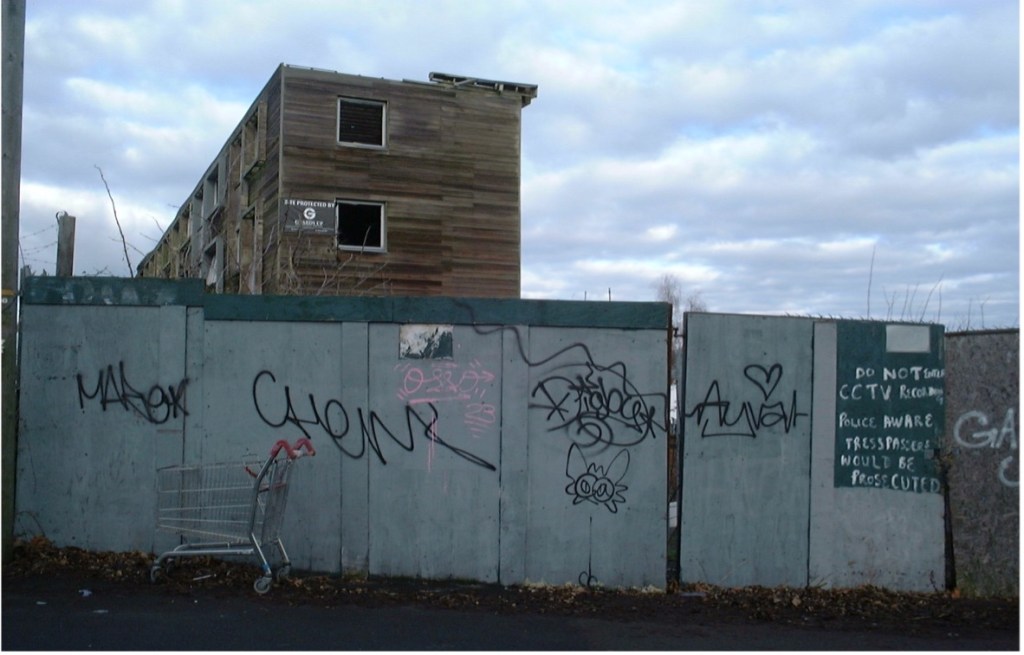
This came from a collection of photographs I took while contemplating the 20th century’s view of a forward-moving future. A collective trajectory toward the year 2000, which, I assume, would weigh heavily on the imaginations of people and their visions of the next millennium. Now, in the 21st century, what do we feel about these expectations of the future? Could we live up to the ideas of a mid-20th-century ideal? Would we even want to? With this photography, I used an early digital camera from the year 1999, using the technology of the time to capture stills of the present, and the weight of the lost future.
An abandoned 1930s cinema, repurposed in the 90s and subsequently left, is the architecture of a once utopian idea of the future. The decay of such a site shows the decay of such ideals, and the block lettering of “futurist” across the top becomes an ironic sentiment.
Calverton Colliery in Nottingham. Shut down the same year this camera was made shows the rapid and unrelenting force of technological ‘improvement’.
A post-war social housing deriving from the modernist dream of communal living in geometric flats and buildings. This modernist dream of the perfectly planned society within the 21st century is abandoned and decaying.




 The Box Zine